
Short answer: a weak or unreinforced garage door can fail under wind pressure before anything else on your house does — and that failure can take the roof with it.
Garage doors are the largest moving opening in most homes, which makes them the biggest single panel exposed to wind load on the entire structure. When straight-line winds or a tropical storm remnant pushes against a house, every wall is sharing that load except one: the garage door, which is held up by tracks, rollers, and springs instead of studs and framing. If that door buckles or blows in, wind rushes into the garage and pressurizes the whole house from the inside out. That internal pressure is often what tears off roof sheathing or blows out windows — not the wind hitting the walls directly. A garage door that holds is doing more structural work than most homeowners realize.
Why this matters more here in October
Chatham County doesn't get direct hurricane landfalls, but it regularly catches the remnants as storms track inland — heavy rain bands followed by gusty, sustained wind that can last longer than a typical afternoon thunderstorm. Combine that with a summer of high humidity and heavy rain that's already had months to work on wood jambs, hardware, and weatherstripping, and a lot of garage doors head into fall storm season already weaker than they were in spring. Pine debris from surrounding trees also tends to pile up in track channels and around door drains this time of year, which can jam a door at the exact moment you need it to seal tight or close fully.
What actually fails first
- Loose track brackets: vibration and years of opening and closing work brackets loose, which lets panels flex side to side under wind load instead of staying rigid.
- Missing or inadequate reinforcement struts: many older doors, especially wider double doors, were installed without horizontal struts across the back of the panels. Without them, the door can bow inward under sustained pressure.
- Corroded hinges and rollers: humidity and summer rain accelerate rust, and a stiff or seized roller puts uneven stress on the track during high wind, increasing the chance of derailment.
- Worn weatherstripping: gaps at the bottom seal, sides, and the astragal between double doors let wind-driven rain inside and give wind a place to catch and push.
What to check and fix before the next storm warning
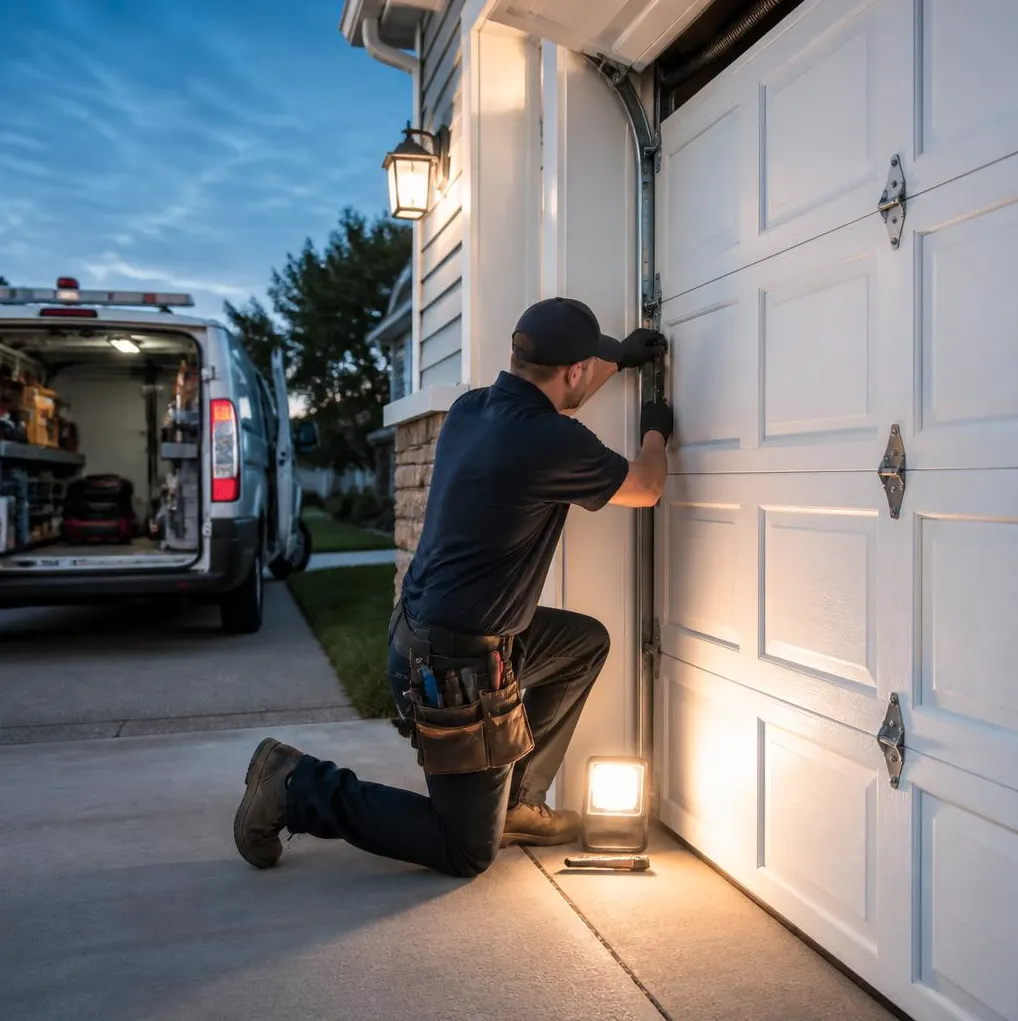
- Tighten every track bracket and hinge screw. This takes a wrench and twenty minutes and is the cheapest thing you can do to reduce flex in the panels.
- Inspect for reinforcement struts. If you can see the back of your door and there are no horizontal bars running across each panel, a retrofit kit can be added without replacing the whole door — this is a lower-cost option than full replacement, though it has limits on how much wind load it can handle compared to a door built wind-rated from the start.
- Clean and lubricate rollers and hinges. A light silicone-based lubricant on rollers and hinges reduces rust buildup and keeps the door moving smoothly under stress instead of binding.
- Replace cracked or flattened weatherstripping on the bottom seal and sides. This is inexpensive and does double duty — keeping wind-driven rain out and reducing the gaps wind can exploit.
- Clear tracks and drainage paths of pine needles and debris so the door can seat fully and water doesn't pool against the bottom seal.
- Know how to manually release the opener trolley. If power goes out mid-storm and you need to operate the door by hand, you should know where that red release cord is before you need it, not during an outage in the dark.
- Keep the door fully closed during high wind events. Cracking it open does not relieve pressure the way cracking a window might — it gives wind a lever to work the door open further, increasing the odds of panel failure.
Reinforce now, or replace with a wind-rated door?
If your door is newer, in good condition, and just needs tightening, lubrication, and a strut retrofit, that's a reasonable and affordable way to improve its wind resistance for this season. But if the door is older, has visible dents or warping, or you're in a more exposed, open part of Chatham County with fewer windbreaks, a full replacement with a wind-rated door is the better long-term call. Wind-rated doors are built with reinforced panels and stronger track systems designed to handle sustained pressure loads, and that difference matters most on the properties that catch the most wind.
When to call Pittsboro Garage Door
If your panels are already dented or bowed, your tracks are bent, or your springs are old enough that you're worried about adding the extra strain of a reinforcement retrofit, that's the point to call in a professional rather than keep patching it yourself. We handle Garage Door Maintenance visits that cover exactly the kind of pre-storm tightening, lubrication, and weatherstripping work described above, and if your door needs more than a tune-up, we can talk through reinforcement kits versus a wind-rated Garage Door Installation based on what your home actually needs. And if a storm has already come through and left you with a door that won't close or has come off its track, our Emergency Garage Door Service is built for exactly that — we show up when we say we will, storm or no storm.
If you're in Pittsboro, Siler City, Chapel Hill, Apex, Sanford, Carrboro, Goldston, or Moncure and want your garage door checked before the next round of fall wind and rain moves through, give Pittsboro Garage Door a call. A thirty-minute inspection now is a lot cheaper than a torn-off roof panel later.